Excavation services
Septic System Installation in the Catskills & Hudson Valley
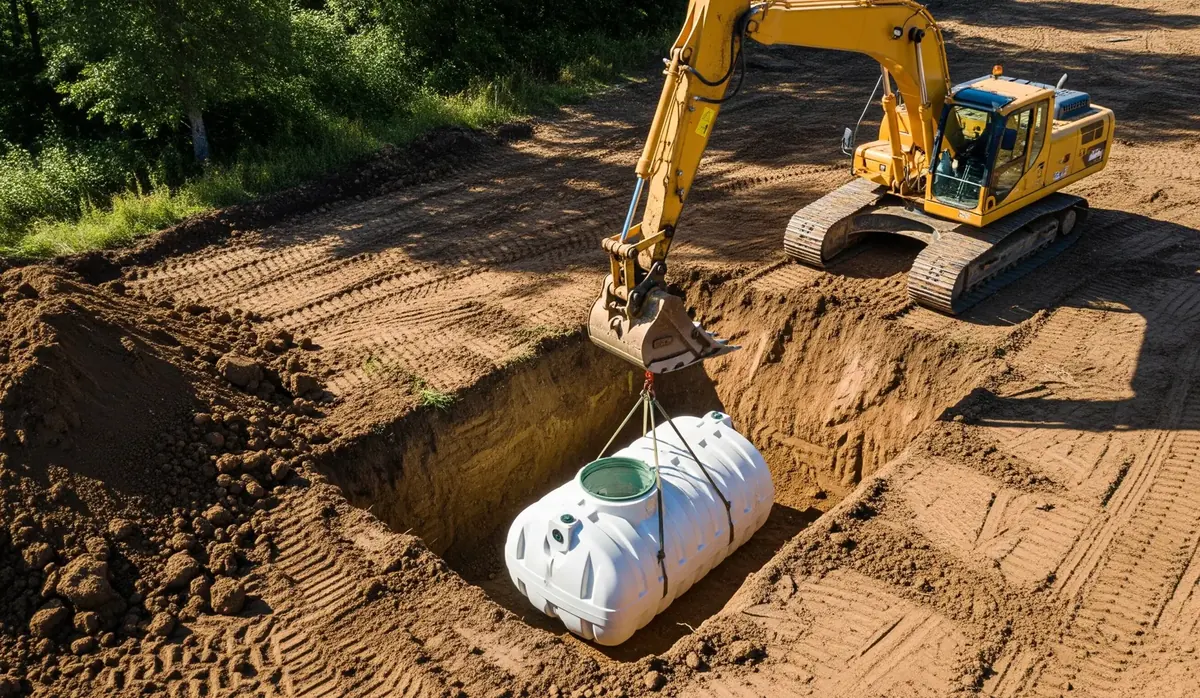
Septic system installation comes down to careful digging: a tank set level on a firm base, leach field trenches cut to the designed depth, and machines kept off the soil that does the treating. Justin also digs sewer laterals, city sewer hookups and old tanks that need to come out, gets underground utilities marked first, and answers the phone around the clock when a line backs up.
How septic system installation works
A septic system is a tank, a distribution box, and a leach field of perforated pipe in stone trenches or beds. The tank holds back the solids. The field lets the liquid soak into the soil, and the soil does the actual treating, which is why it matters so much. New and replacement systems are generally designed for the specific site based on soil and percolation tests, and approved before any digging starts.
In the mountains, the ground is often the hard part. Shallow bedrock, dense hardpan and a seasonal high water table leave too little usable soil under the field, so the design may call for a raised system built up with fill. Near the Hudson, heavy clay drains slowly and can need a larger field. Either way, the excavation has to follow the plan exactly: the tank set level on a firm base, field trenches dug to the specified depth and kept level, and heavy equipment kept off the field area so the soil isn't compacted before the pipe goes in.
When a house switches from septic to city sewer, the old tank gets pumped, then removed or crushed and filled so nobody falls into it years later.
Sewer lines and city hookups
The pipe from your house to the main in the street is the lateral, and it's usually the homeowner's responsibility, at least up to the property line. In older neighborhoods in Kingston, Hudson and Catskill village, a lot of laterals are clay tile or cast iron that has been in the ground for generations. Roots get into the joints, sections crack or sag, and one day the line backs up into the basement.
Replacing a lateral means digging the full run, laying new pipe on a steady downhill pitch with no bellies, making a proper connection at the main and at the house, and bedding and backfilling carefully so the pipe isn't crushed or knocked off grade. Connections to a municipal sewer generally need a permit and an inspection, and the village or city will tell you who is allowed to make the tap.
What should you do if your sewer backs up into the basement?
Stop using water in the house right away: no flushing, laundry or showers, since every gallon ends up on the basement floor. Keep people and pets away from the sewage. Then call for help. If the blockage is in the lateral outside, it often means the pipe is broken, collapsed or packed with roots.
Justin offers 24/7 emergency service for sewer backups. When the line is broken outside the house, the fix is usually digging it up and replacing the bad section or the whole run. One customer's review describes Justin on site within an hour and the whole line replaced within 36 hours of the first call. See emergency excavation for how those calls work.
Cost drivers and mistakes to avoid
The big variables are the length and depth of the run, rock, groundwater, and what sits on top of the line. A paved driveway, a patio, a sidewalk or the street itself all have to be cut and restored. A deep main in a village street can mean a deep, shored trench, which is slower work. Septic jobs add the question of whether the old field can be reused or a new one has to go somewhere else on the lot.
- Don't drive or park on a leach field. It crushes pipe and compacts the soil.
- Don't plant trees or shrubs near the tank or field. Roots find the pipe.
- Don't build over the tank lid or bury it so deep it can't be pumped.
- Don't leave an abandoned tank in place without crushing and filling it.
Most of the digging itself is the same skill as any utility trenching job, done with more attention to pitch.
Word around town
From customers who called Justin.
After calling several other companies and receiving no response I happened upon JM Hoeing. Justin was on-site within an hour and got right to work addressing a blocked main sewage line that was spilling out into my basement. He had the entire line replaced within 36 hours of the initial phone call!
Genuine guy who is responsive and responsible. Justin was reasonable when my project changed scope a few times. Felt like he cared about leaving me with quality work and a positive experience. Handled septic removal/crushing, and hook-up to city sewer with extensive site grading.
Straight answers
Sewer & Septic: common questions
How long does a sewer line replacement take?
Many residential laterals can be dug and replaced in a day or two once the permit and inspection are lined up. Long runs, deep mains, rock or a street cut take longer. In an emergency, the goal is to get the line working first and restore the surface after.
Do I need a permit for septic or sewer work?
Almost always for a new or replacement septic system, and usually for a connection to a municipal sewer. Rules vary by town and county, so check with your local code office or health department before scheduling the work.
Can you switch my house from septic to city sewer?
Yes, if there's a sewer main available and the municipality allows the connection. The job usually includes the new lateral, the connection, removing or crushing and filling the old tank, and grading the yard afterward.
How do I know if my septic field is failing?
Soggy ground or a sewage smell over the field, slow drains all through the house, gurgling pipes, or bright green strips of grass over the trenches are the usual signs. Have the tank pumped first, since a full tank can look like a failed field. If the field itself is done, it needs a new design and new excavation.
Often paired with
Related work.
- Trenching
Utility Trenching
Trenches for water, sewer, electric and propane lines, dug to depth and backfilled.
- 24/7
Emergency Excavation
24/7 help for water line breaks, sewer backups, drainage failures and storm damage.
- Drainage
Drainage & Erosion Control
French drains, curtain drains, swales and culverts for wet yards, basements and washouts.
No charge to look
Get a Free Excavation Estimate
Tell Justin what you've got going on. He'll call you back, come out and walk it, and give you a straight price.
(518) 947-4330 jmhoeing@yahoo.com- Free estimates on every job
- Licensed & insured
- Underground utilities marked before we dig. Justin handles it.
- Emergency calls answered 24/7