Excavation services
Pool and Pond Excavation in the Catskills & Hudson Valley
Pool and pond excavation around here comes down to what's under the grass: shallow ledge, stony glacial till, or wet clay. Justin walks your yard, looks at access and water, and tells you straight what the dig will take before a single bucket of dirt moves.
How a Pool Dig Actually Goes
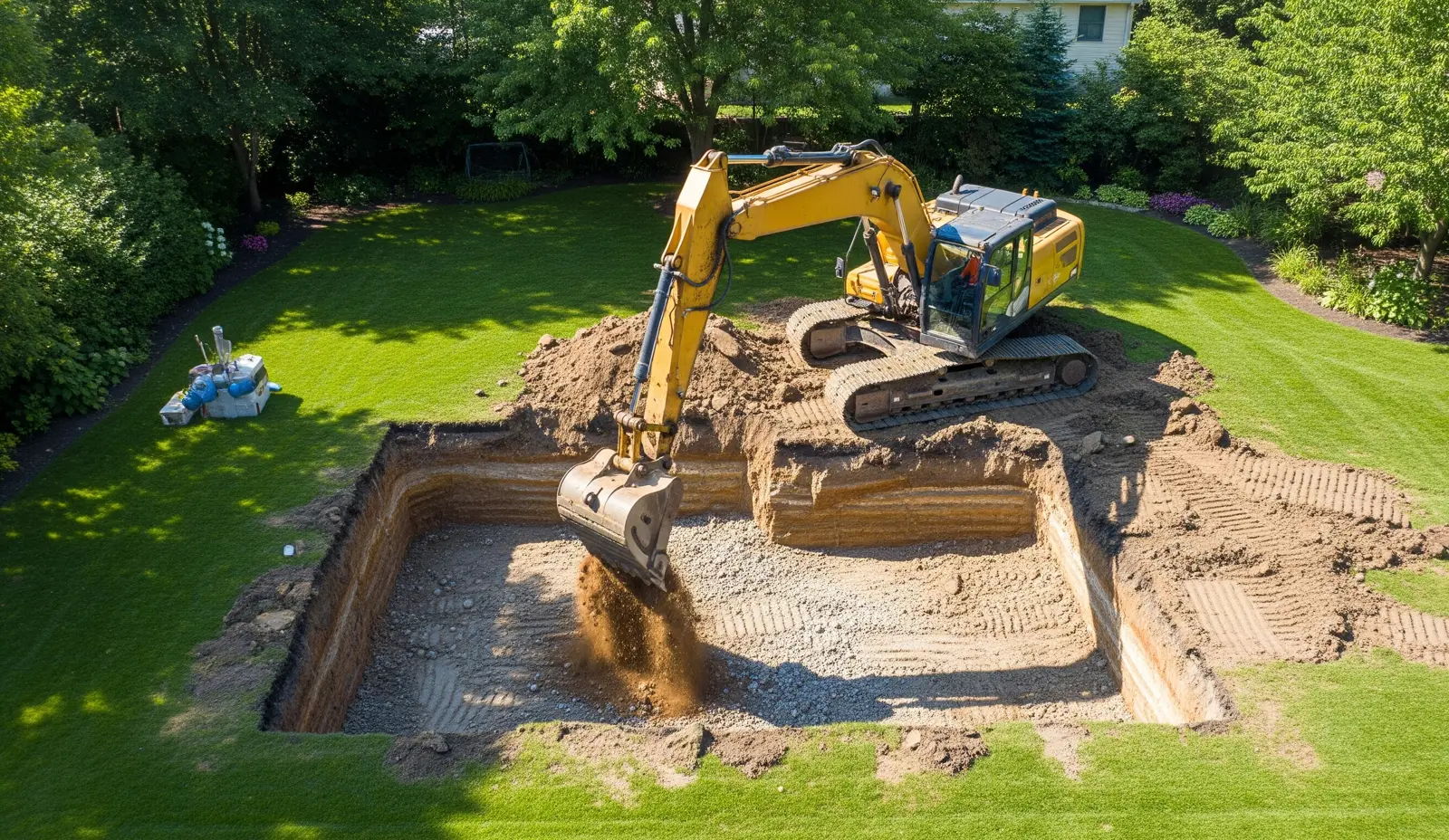
Your pool installer supplies the dig spec: the shape, the depth at the shallow and deep ends, and how much overdig they want around the walls for bracing and backfill. Justin lays it out with paint and stakes, checks it against the plan, and gets underground utilities located and marked before digging starts. The topsoil comes off first and gets piled separately, because you'll want it back for the lawn later.
The hole is dug to grade, not eyeballed. The floor has to be flat and firm where it's flat, and shaped where the deep end slopes down. If the machine overdigs a spot, it gets filled with compacted stone, never loose dirt that will settle under the liner. Once the installer's walls are up and plumbed, backfill goes in around them in layers.
A backyard pool turns out more dirt than people expect. Soil fluffs up once it's dug, so a mid-size pool can easily mean a hundred cubic yards or more. Decide early whether it gets spread on the property, used to build up a patio area, or trucked away. That one decision changes the price more than most people realize.
What Drives the Cost and Time of Pool and Pond Excavation
Rock is the big one. In the mountain towns around Hunter and Windham, bedrock can sit a few feet down, and glacial till is packed with stones from fist-size to car-size. A bucket moves till fine, just slowly. Solid ledge at the deep end may need breaking, or a design change to a shallower pool. Our page on rock and boulder removal explains how that part works.
After rock, these set the schedule and the bill:
- Access: the machine and trucks need a path to the backyard. Fences, septic fields, tight side yards and soft lawns all add time.
- Water: a high water table or a spring seep fills the hole while you dig. That means pumping, and sometimes a drain under the pool.
- Haul-off: every truckload of dirt or rock leaving the site costs money, and long trips add up.
- Slope: a pool on a hillside needs a cut on one side and fill or a wall on the other.
Does a Pond Need a Clay Liner?
Only if your soil won't hold water on its own. Heavy clay, like a lot of the ground near the river around Hudson and Catskill, often seals itself once it's compacted. Gravelly till and cracked ledge up in the mountains usually leak. A test hole filled with water tells you a lot before you commit to anything.
Where the soil won't hold, you can bring in clay and compact it in layers across the bottom and sides, or use a synthetic liner. Either way, a pond needs a few things designed in from the start: a water source (a spring, runoff or a high water table), an overflow spillway so a big storm doesn't cut through the bank, and side slopes gentle enough to stay put and to let someone climb out. Steep banks slump after the first freeze-thaw. If a stream or wetland is involved, state and local permits can come into play, so sort that out before digging, not after.
Getting Your Yard Ready, and the Mistakes to Avoid
Before dig day, have the pool company's plan and dig spec in hand and confirm any town permit is done. Tell Justin where your septic tank, leach field, well line and any buried electric or propane lines run, if you know. Clear the access path of cars, play sets and anything you care about, and give your neighbors a heads-up that trucks are coming.
Most problems come from rushing. Don't set a pool in the low spot of the yard, where every rain drains toward it. Don't backfill with the rocky spoil that came out of the hole, since stones against a pool wall cause trouble. Don't start in early spring while the ground is still thawing and soft; late spring through fall is the usual window. And plan the grading around the pool at the same time. Good grading and landscape prep after the pool goes in is what makes the yard drain and look finished.
Word around town
From customers who called Justin.
Justin has done several jobs for us always professional and courteous even when we change things in the middle of the project! Job sites are clean, neat and work is amazing. Highly recommend his work.
Straight answers
Pools & Ponds: common questions
How long does it take to dig an in-ground pool?
In decent soil with good access, the dig itself often takes a day or two. Rock, groundwater or a tight backyard can stretch that out. Justin will give you a realistic timeline after he's seen the site.
Can you dig a pond on rocky property?
Often, yes, but rocky and gravelly ground usually needs a liner or imported clay to hold water. A test hole is the cheapest way to find out. Justin can tell you on the site walk whether the spot you picked makes sense.
What happens to all the dirt from a pool dig?
You choose. It can be spread and graded on your property, used to build up a level area, or hauled away. Keeping it on site is usually cheaper, as long as it goes somewhere that won't block drainage.
Do you do pool and pond excavation near me?
Justin is based in Palenville and works across Greene, Ulster and Columbia counties, from Hunter and Windham to Kingston, Hudson and Kinderhook. Call (518) 947-4330 or use the quote form for a free estimate.
Often paired with
Related work.
- Site Prep
Site Excavation & Prep
Foundation digs, footings, pier holes and backfill for homes and additions.
- Rock
Rock & Boulder Removal
Boulders, ledge and stony till dug out, reused on site or hauled away.
- Drainage
Drainage & Erosion Control
Curtain drains, swales, culverts and regrading for wet yards, basements and washouts.
No charge to look
Get a free quote.
Tell Justin what you've got going on. He'll call you back, come out and walk it, and give you a straight price.
(518) 947-4330 jmhoeing@yahoo.com- Free estimates on every job
- Licensed & insured
- Underground utilities marked before we dig. Justin handles it.
- Emergency calls answered 24/7