Excavation services
Land Clearing in the Catskills & Hudson Valley
Land clearing turns an overgrown or wooded lot into ground you can build on, drive on or mow, with the brush out, the stumps pulled and the site ready for the next step. Justin clears house sites, driveway corridors and old fields across the Catskills and Hudson Valley, and he leaves standing the trees you want kept.
What land clearing includes, and what it doesn't
Clearing is more than knocking down brush. A proper job has three parts: removing the vegetation, grubbing out the stumps and roots, and stripping the topsoil wherever something will be built. Skip the grubbing and you get a pad that settles as the roots rot. Skip saving the topsoil and you'll pay to bring it back when it's time to seed.
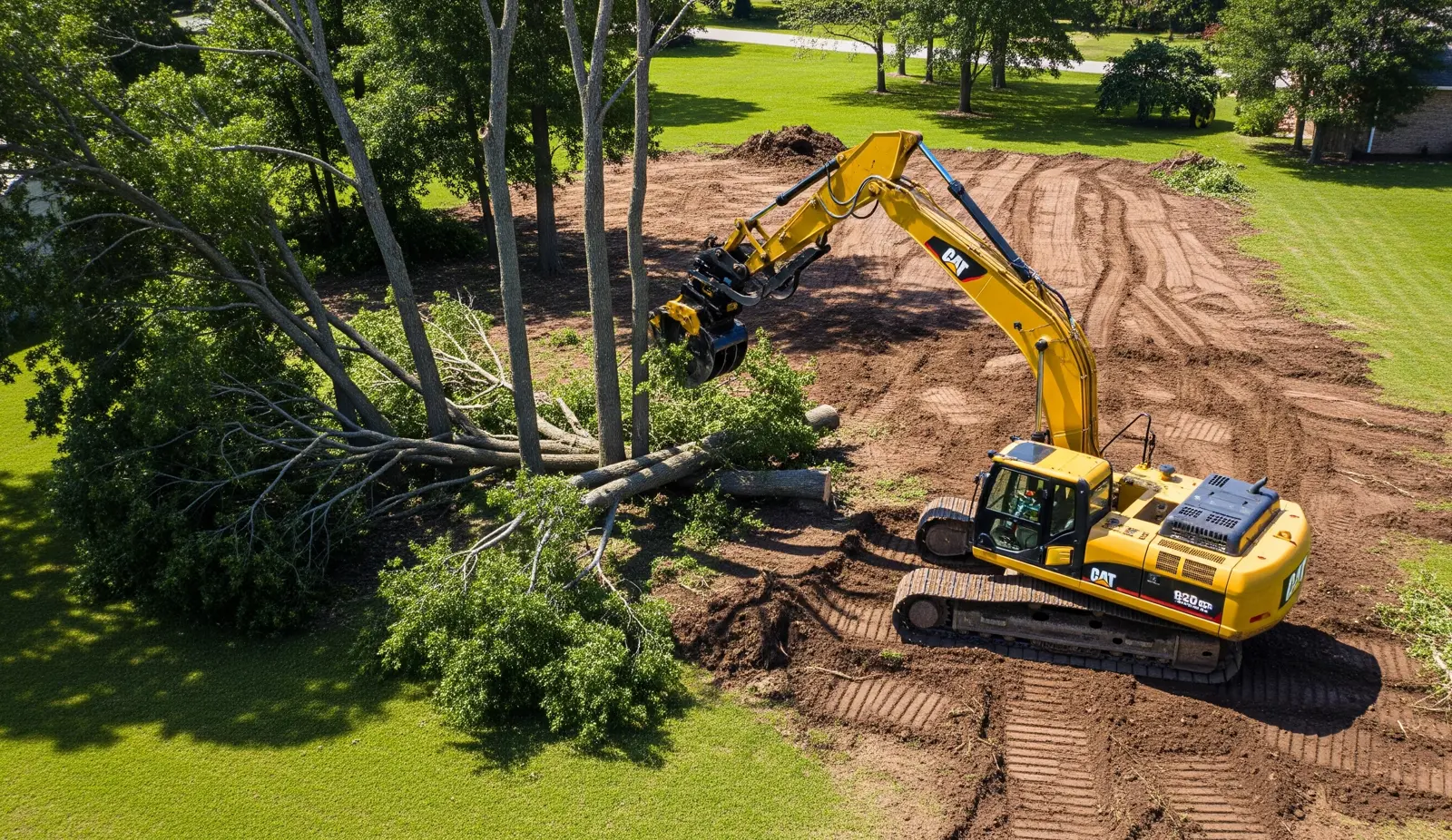
It also means deciding what stays. Before any machine moves, walk the lot and flag the trees you want to keep with ribbon. A mature oak or maple at the edge of a clearing is worth protecting, and that means keeping machines, fill and stockpiles off its roots, which spread at least as far out as the branches. Big trees leaning over the house or tangled in power lines are a job for a tree service or the utility's line crew. The excavator comes in after that to deal with the stumps and cleanup.
Mountain lots versus Hudson Valley fields
Up in Hunter, Windham and the hills around Palenville, lots are usually steep, wooded and rocky. Stumps grow wrapped around boulders, and pulling one often brings up a stone the size of a washing machine with it. Soil is thin over the rock, so there isn't much topsoil to save, which is exactly why it's worth saving all of it. On slopes, clear only what you need and only as far ahead of the build as you have to, because bare ground on a hill washes out fast in a summer thunderstorm.
In the flatter country toward the Hudson, around Germantown, Chatham and Kinderhook, the work is more often reclaiming old fields and hedgerows that have grown up in brush and saplings, or opening a long driveway corridor. The ground is easier to dig, but the clay turns greasy when it's wet and heavy equipment ruts it badly in spring.
What happens to the stumps, brush and logs?
That depends on what you want and what the site allows. Good logs can be cut and left for your firewood. Brush and stumps are usually hauled off or chipped, since open burning is heavily restricted in New York. The one thing you shouldn't allow is burying stumps where you'll build or drive: they rot and the ground sinks.
Cost and time follow from a few things: how thick and how big the growth is, how many stumps there are, how much rock comes up with them, the slope, and how easily trucks can get in to haul debris out. A lot full of scrubby saplings goes quickly. A hillside of big stumps wound around boulders doesn't. When the stumps come out, the rock often comes with them, so it helps to plan for rock and boulder removal at the same time.
Getting ready, and mistakes to avoid
Know your property lines before anyone cuts. If the pins aren't visible, have a surveyor find them. Clearing a neighbor's trees is an expensive apology. Find out whether any part of the lot is wetland or streambank too, because clearing near water can need a permit and can get you in trouble fast. Then settle on the end use: a house site, a driveway, a lawn and a pasture all get cleared differently.
The most common mistake is clearing everything at once and letting it sit through a wet season. Bare soil erodes, ruts, and sprouts a new crop of weeds and saplings within a year. Clear in step with the build, and get seed and mulch or proper erosion control on any ground that will sit bare for a while.
Word around town
From customers who called Justin.
Justin has done several jobs for us always professional and courteous even when we change things in the middle of the project! Job sites are clean, neat and work is amazing. Highly recommend his work.
Straight answers
Land Clearing: common questions
How much does land clearing cost per acre?
There's no honest per-acre number without seeing the land. An acre of old field with scattered saplings and an acre of mature woods on a rocky slope are completely different jobs. Justin walks the site for free and prices the work you actually need.
When is the best time of year to clear land?
Summer and fall are usually easiest, when the ground is firm and dry. Clearing on frozen ground in winter can also work well and does less damage to the soil. Spring mud season is the worst time, because machines rut the ground and trucks may face road weight limits.
Do I need a permit to clear my land?
Clearing on your own property often doesn't need one, but there are real exceptions, especially near wetlands and streams, on steep slopes, or where a town has site plan rules. Ask your town's building or code office before a large clearing.
Can you clear just the building site and leave the rest wooded?
Yes, and that's often the smartest plan. Selective clearing keeps shade, privacy and the value of mature trees, and it cuts down on erosion. Flag what you want kept and Justin will work around it.
Often paired with
Related work.
- Site Prep
Site Excavation & Prep
Foundation digs, footings, pier holes and backfill for homes and additions.
- Rock
Rock & Boulder Removal
Boulders, ledge and stony till dug out, reused on site or hauled away.
- Grading
Grading & Landscape Prep
Rough and fine grading, compacted fill and topsoil ready for lawn, patio or beds.
No charge to look
Get a free quote.
Tell Justin what you've got going on. He'll call you back, come out and walk it, and give you a straight price.
(518) 947-4330 jmhoeing@yahoo.com- Free estimates on every job
- Licensed & insured
- Underground utilities marked before we dig. Justin handles it.
- Emergency calls answered 24/7