Excavation services
Utility Trenching in the Catskills & Hudson Valley
Utility trenching is how water, sewer, electric and propane lines get from the road or the well to your house, barn or garage without being dug up again in five years. Justin digs to the right depth, keeps the trench straight and clean, and backfills so the line is protected and the lawn doesn't sink.
What goes in a utility trench
Most residential trenching is one of a handful of jobs:
- Water service from a well or a municipal main to the house
- Sewer laterals and lines to a septic tank (see sewer and septic excavation)
- Underground electric to a house, garage, barn or generator
- Propane lines, and conduit for internet or low-voltage wiring
- Footing drains and downspout lines
Each has its own depth and bedding requirements, set by the plumber, electrician, utility company and local code, not by guesswork. A water line has to sit below frost depth, which is about 4 feet in most of this area, or it will freeze. Electric conduit has its own required cover. Before digging, Justin gets the existing underground utilities located and marked so a new trench doesn't cut an old line.
How utility trenching gets done
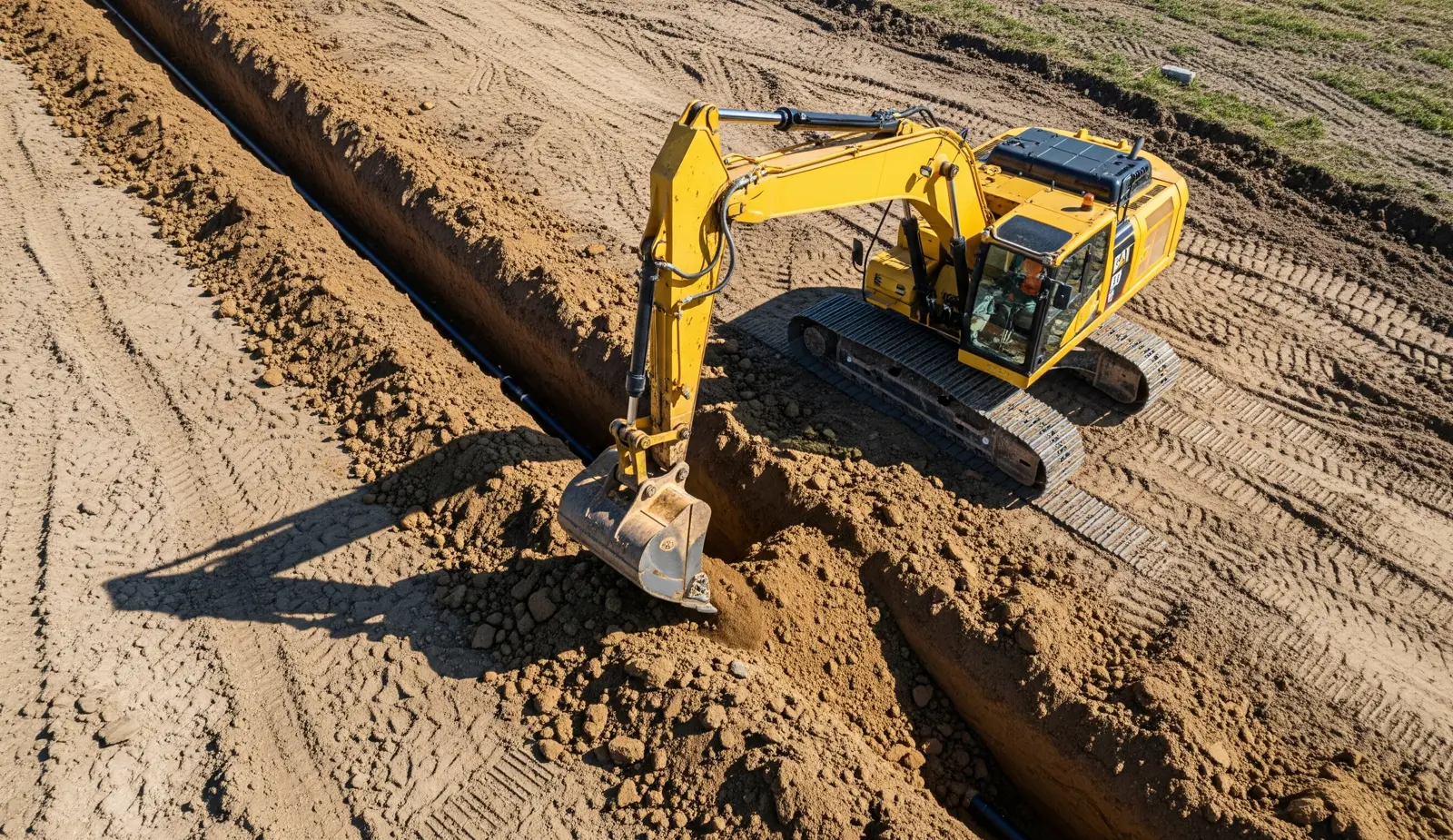
The route comes first. Straight and short is cheapest, but the best route also avoids the septic field, big trees, ledge, and anywhere trucks will drive every day. Then the trench is dug to grade and the bottom is cleaned of rocks. In stony ground, the pipe or conduit gets a bed of sand or fine material under and over it, because a sharp stone pressed against plastic pipe by 4 feet of backfill will eventually wear through. Warning tape goes in above the line, so the next person to dig there finds tape before they find pipe.
Often the line has to be inspected before it's covered, so the trench may sit open until the inspector comes. After that, it's backfilled in lifts and compacted, with the topsoil going back on top. A trench that sinks into a ditch across the lawn a year later is almost always a compaction problem.
What makes a trench slow or expensive?
Length, depth and what's in the ground. A 4-foot trench through sandy loam goes quickly. The same trench through glacial till full of cobbles, or across ledge that has to be broken, can take several times as long. Crossing a driveway or walk, working around a high water table, and tight access all add time too.
In the mountain towns, rock is the big unknown. On some lots bedrock sits a couple of feet under the surface, and a water line can't live in 2 feet of cover. Sometimes the answer is a different route, sometimes it's insulation over the line where the plumber and code allow it, and sometimes it means breaking the rock (see rock and boulder removal). Near the Hudson, clay digs easily but doesn't stand well when it's wet, so trench walls can slump.
Trench safety and mistakes to avoid
A deep trench is one of the most dangerous places on any job. Walls can collapse without warning, especially in wet or sandy soil, and even a small cave-in can trap a person. Deep trenches need to be sloped, benched or shored before anyone climbs in, and kids and pets need to stay well clear of an open trench.
The other common mistakes: running water and sewer lines together without the separation the code requires, leaving out tracer wire or warning tape, and backfilling with the big rocks that came out of the hole. Plan ahead while the ground is open. If you might add a generator, a barn or a detached garage someday, laying an extra empty conduit now costs very little compared with digging a second trench later. If the trench is part of a new build, it's often done alongside the site excavation.
Word around town
From customers who called Justin.
Justin did the sewer hookup for my home. Issues that arose during the job, he helped quickly to resolve. He is professional and is one of the quality contractors in the Catskill area
Straight answers
Utility Trenching: common questions
How deep does a water line need to be around here?
Deep enough to stay below frost, which is about 4 feet in most of the Catskills and Hudson Valley, and many plumbers go a little deeper for margin. Where rock makes that impossible, the line needs another way to stay unfrozen. Your plumber and local code set the final depth.
Can you dig the trench for my electrician or plumber?
Yes, that's how most trenching jobs work. Justin digs and backfills, and the licensed trade sets the pipe or wire and handles connections and inspections. It helps to have everyone agree on depth and route before the machine shows up.
Will the trench wreck my lawn?
You'll see a scar for a season. The topsoil is kept separate and put back on top, and the trench is compacted so it doesn't sink. Seed it, and in most cases it's hard to find by the next summer.
Do you do utility trenching near me?
Justin works out of Palenville and covers Greene, Ulster and Columbia counties, including Catskill, Saugerties, Woodstock, Kingston, Hudson and the towns in between. Call (518) 947-4330 to set up a free site visit.
Often paired with
Related work.
- Septic
Sewer & Septic
Sewer laterals, city hookups, septic tanks and leach fields. 24/7 for backups.
- Site Prep
Site Excavation & Prep
Foundation digs, footings, pier holes and backfill for homes and additions.
- Rock
Rock & Boulder Removal
Boulders, ledge and stony till dug out, reused on site or hauled away.
No charge to look
Get a free quote.
Tell Justin what you've got going on. He'll call you back, come out and walk it, and give you a straight price.
(518) 947-4330 jmhoeing@yahoo.com- Free estimates on every job
- Licensed & insured
- Underground utilities marked before we dig. Justin handles it.
- Emergency calls answered 24/7