Excavation services
Drainage and Erosion Control in the Catskills & Hudson Valley
Drainage and erosion control means deciding where water goes on your property before it decides for you, whether that's into the basement, down the driveway, or across the lawn taking the topsoil with it. Justin builds curtain drains, French drains, swales, culverts and stone-lined ditches, and he's on call 24/7 when a storm washes something out.
Why water is such a problem on local lots
On the mountain side, most soil is glacial till: a dense mix of clay, sand and stones sitting on bedrock or a hardpan layer. Rain soaks in a short way, hits that layer, and then runs sideways downhill underground until it comes out somewhere, often against the uphill side of a foundation or in the middle of a driveway. Add steep slopes, spring snowmelt and hard summer thunderstorms, and you get wet basements, washed-out driveways and gullies.
Near the Hudson, the problem runs the other way. Clay soils barely absorb water, so it sits on the surface, ponds in low spots and stays there. A dry well that works fine in sandy ground can fill up and stay full in clay. The fix has to match the ground, which is why it pays to look at a site in the rain, or right after.
Drainage fixes that actually work
Most drainage problems are solved with a few proven tools, used in the right place:
- Regrading so the ground slopes away from the house, which alone fixes a lot of wet basements
- Curtain drains: gravel trenches with perforated pipe on the uphill side, to catch groundwater before it arrives
- French drains and footing drains that collect water where it gathers and carry it off
- Swales and stone-lined ditches that move surface runoff without eroding
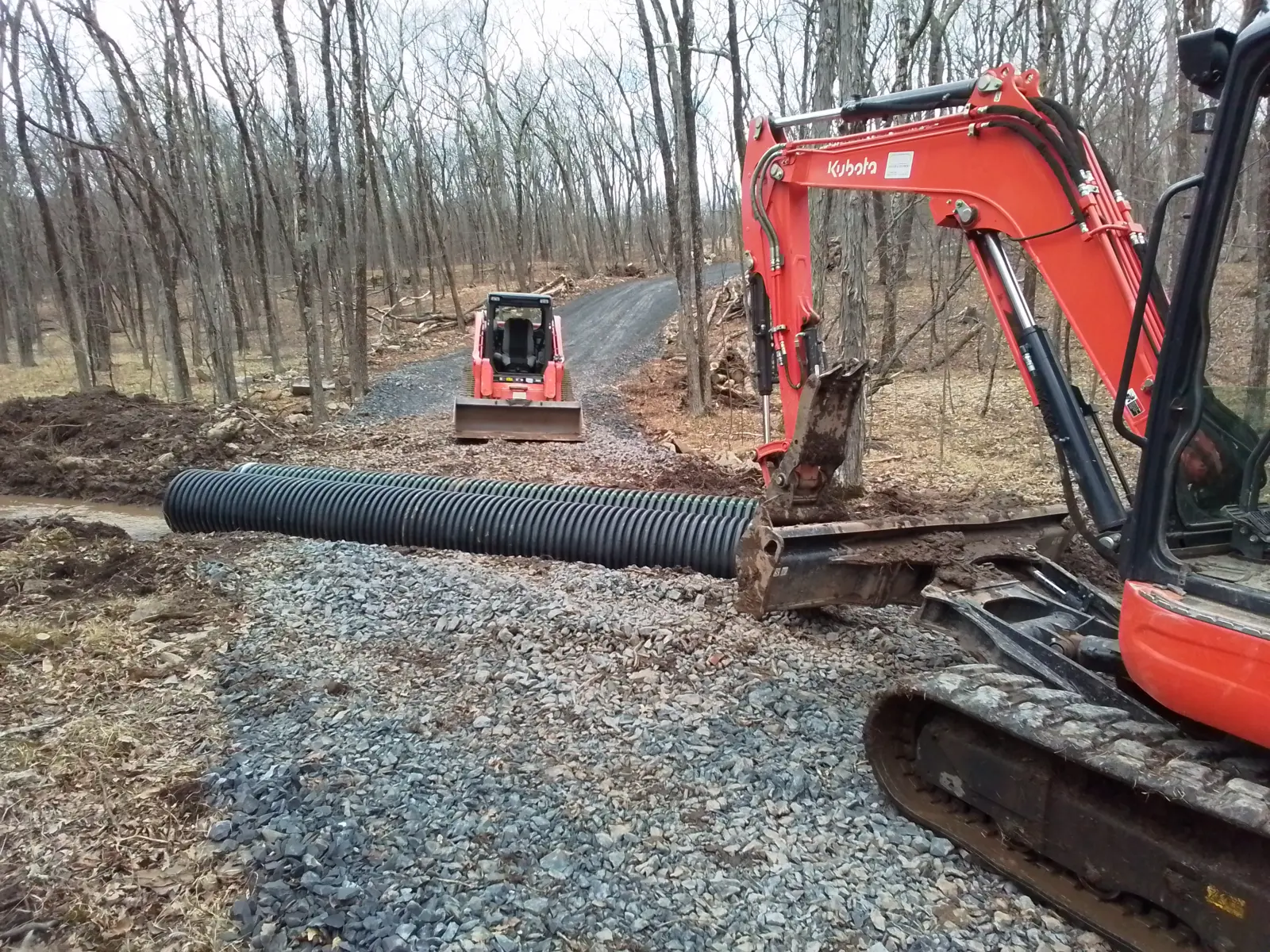
- Culverts under driveways, sized for the big storm and not just an average rain
The part people forget is the outlet. Every drain has to go somewhere lower, ideally out to daylight downhill, and it can't be aimed at the neighbor's property. A drain with nowhere to go is just an underground bathtub. For the shaping side of the work, see grading and landscape prep.
How do you stop erosion on a steep slope?
Slow the water down and get roots into the ground. That means breaking up long runs of water with swales or diversions, lining channels that carry heavy flow with stone, and covering bare soil with seed and straw mulch or erosion blanket right away. On the steepest banks, a retaining wall or stone armor may be the only lasting answer.
During construction, silt fence along the low side of disturbed ground keeps mud out of streams and roads, and clearing only what the project needs cuts the problem off at the source. Larger disturbed areas can bring stormwater permit requirements, so ask the town early on a big project. Where a bank keeps sliding, a retaining wall with drainage behind it holds the slope for good.
What drives the cost, and mistakes to avoid
Cost comes down to how much water there is, how far it has to travel to reach an outlet, what the trench runs through (ledge is slow, wet clay is heavy and messy), and what has to be torn up and put back, like a driveway, patio or finished lawn. Access counts too: a curtain drain above a house on a steep, tight lot is slower work than one across an open yard.
The common mistakes: skimping on filter fabric and clean stone so the drain silts up in a few years, putting the drain at the bottom of the wet spot instead of above it where the water comes in, tying downspouts into footing drains, and paying for basement waterproofing when the real problem is a yard that slopes toward the house. Get the surface water right first. It's usually the cheapest part. When a storm has already done the damage, emergency excavation gets things stable fast.
Word around town
From customers who called Justin.
Genuine guy who is responsive and responsible. Justin was reasonable when my project changed scope a few times. Felt like he cared about leaving me with quality work and a positive experience. Handled septic removal/crushing, and hook-up to city sewer with extensive site grading.
Straight answers
Drainage & Erosion Control: common questions
What's the difference between a French drain and a curtain drain?
Both are gravel trenches with perforated pipe. A curtain drain sits uphill of the area you want to protect and intercepts groundwater before it gets there, while a French drain usually collects water where it already pools. On hillside lots up here, the curtain drain is often the one that solves the problem.
When is the best time to fix a drainage problem?
Diagnose it when it's wet, during spring melt or after a big rain, so you can see where the water really goes. Do the digging when the ground is firmer, usually summer or fall. Emergency washouts get fixed when they happen.
Do you repair storm damage and washed-out driveways?
Yes. Justin offers 24/7 emergency service for drainage failures and storm damage, including washed-out driveways, blocked culverts and eroded banks. Call (518) 947-4330.
Will a drain fix my wet basement?
Often, if the water is coming from the ground outside. Check the simple things first: gutters, downspouts dumping next to the foundation, and ground that slopes toward the house. Justin walks the site and tells you what he thinks is causing it before anything gets dug.
Often paired with
Related work.
- Grading
Grading & Landscape Prep
Rough and fine grading, compacted fill and topsoil ready for lawn, patio or beds.
- Walls
Retaining Walls
Block, stone and boulder walls built on a real base with drainage behind them.
- 24/7
Emergency Excavation
24/7 help for water line breaks, sewer backups, drainage failures and storm damage.
No charge to look
Get a free quote.
Tell Justin what you've got going on. He'll call you back, come out and walk it, and give you a straight price.
(518) 947-4330 jmhoeing@yahoo.com- Free estimates on every job
- Licensed & insured
- Underground utilities marked before we dig. Justin handles it.
- Emergency calls answered 24/7