Excavation services
Driveway Installation in the Catskills & Hudson Valley
Driveway installation in the Catskills is mostly about what's under the gravel: a solid base, a crown that sheds water, and ditches and culverts that keep spring runoff from tearing it apart. Justin builds and rebuilds gravel driveways, from short parking pads to long, steep runs up wooded hillsides.
What Goes Into a Driveway That Lasts
A driveway is a small road, and it fails the way roads fail: water gets under it. The build usually goes like this. Topsoil, roots and organic material get stripped down to firm subgrade, because anything soft left underneath turns into ruts. Wet or clay spots may get geotextile fabric to keep the stone from sinking into the mud. Then comes a thick base of crushed stone (a lot of people around here call it Item 4), spread in layers and compacted, and a finer top layer that packs hard and drives smooth.
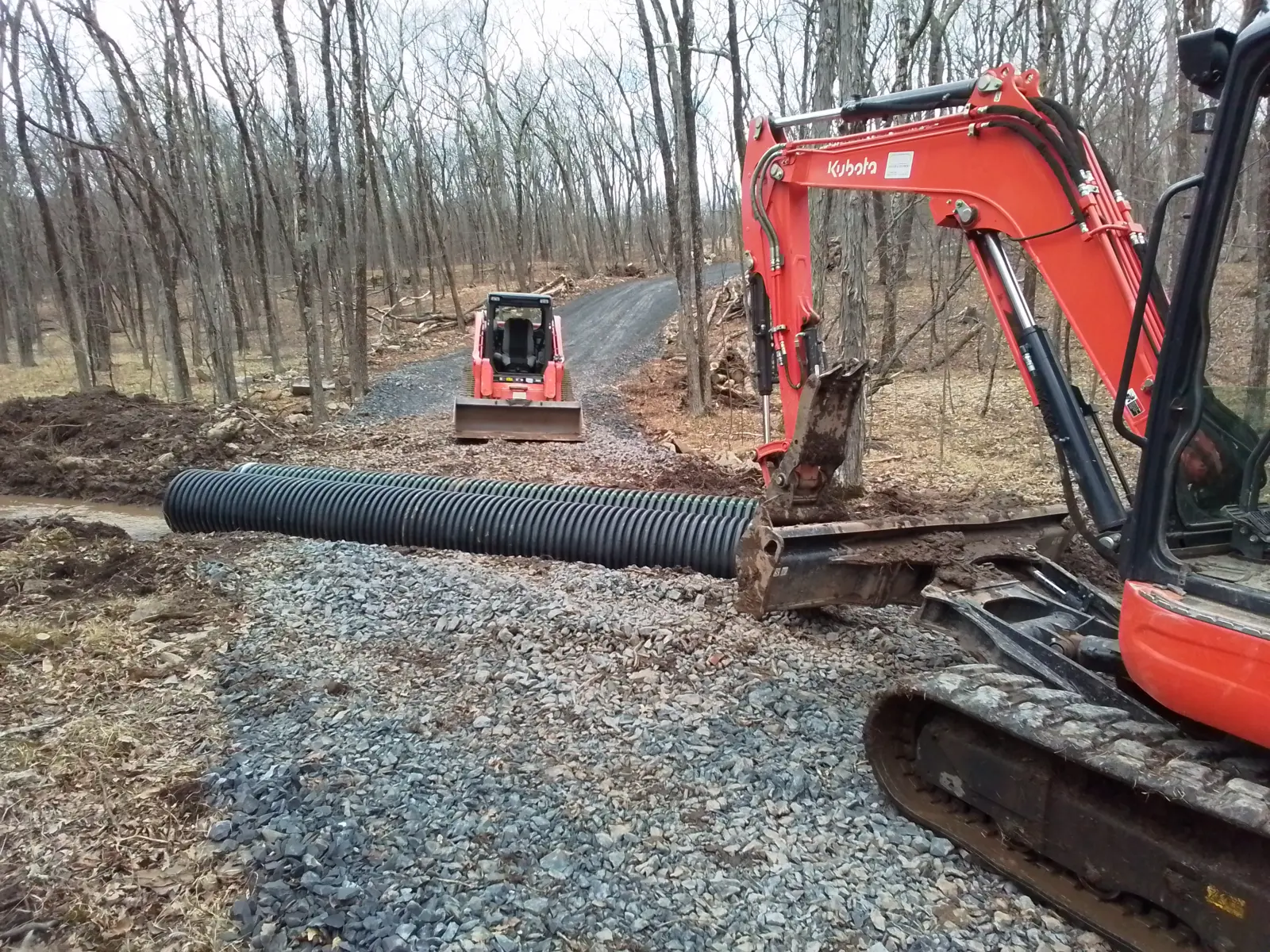
The surface gets a crown or a cross slope so water runs off the side instead of down the middle. Along the edges, ditches or swales carry that water away, and a culvert goes under the driveway wherever a ditch or stream has to cross. Skip any of that and the driveway washes out, usually in March or April.
Driveway Installation on Steep, Wooded Lots
Long gravel driveways climbing a hillside are common in the mountain towns, and they're the hardest to get right. Water picks up speed on a grade, and a driveway that's also the lowest path downhill becomes a stream in every storm. The fix is to get water off the surface often: shallow dips or diversions angled across the drive, stone-lined ditches on the uphill side, and culverts sized for real spring runoff, not a summer shower. Our drainage and erosion control page covers that side in more detail.
Wooded lots need clearing wide enough for the driveway, the ditches and snow storage, plus trimming overhead for trucks, so land clearing usually comes first. Rock matters too: ledge in the path may make a slight reroute cheaper than breaking it out. And think about the plow. Tight curves and steep, narrow spots are where plow trucks get stuck and edges get torn up.
How Long Does a New Gravel Driveway Take?
A short, simple driveway on firm ground can often be built in a few days. A long mountain driveway with clearing, rock, culverts and ditching takes longer, sometimes a couple of weeks. Weather matters too, since wet ground slows everything and shouldn't be compacted. Justin gives you a realistic schedule after walking the whole route.
Existing driveways don't always need a full rebuild. If the base is sound but the surface is potholed and rutted, regrading, reshaping the crown and adding a fresh top layer can bring it back. If mud is pumping up through the stone, the soft spots need to be dug out and rebuilt from the bottom.
What Drives the Cost, and Mistakes to Avoid
Length and width set how much stone you need. After that, cost comes from ground conditions (clay and wet spots need more base and fabric), rock, the number of culverts, how much ditching the route needs, and how far the stone has to be trucked. A long driveway uses a lot of material, and delivery adds up. Good grading where the driveway meets the house and yard matters just as much as the drive itself.
The common mistakes are predictable:
- Laying stone right on topsoil. It sinks, and you end up buying the same stone twice.
- Skipping the crown and ditches to save money. The first spring washout costs more.
- Undersizing culverts, which clog or overflow and wash out the drive at the crossing.
- Topping with round gravel. It rolls under tires and never locks together.
If you plan to pave later, build the gravel base now as if the asphalt were going down next week. The base is what makes pavement last.
Word around town
From customers who called Justin.
Justin has done several jobs for us always professional and courteous even when we change things in the middle of the project! Job sites are clean, neat and work is amazing. Highly recommend his work.
Straight answers
Driveways: common questions
Do I need a permit for a new driveway?
Often, especially where the driveway meets a public road, since a new entrance usually needs approval from whoever maintains that road. Requirements vary by town and road. Sort it out before work starts so the entrance is built to their standard.
Can you fix my washed-out gravel driveway?
Yes. The first step is finding where the water is coming from, because refilling a washout without fixing the drainage just sets up the next one. That usually means reshaping the crown, cleaning or adding ditches, and sometimes adding a culvert.
What's the best stone for a gravel driveway?
Crushed stone with angular edges and a mix of sizes, including fines, packs hard and stays put. Round gravel looks nice but rolls and ruts. The base layer is coarser, with a finer layer on top.
Do you do driveway installation near me?
Justin works from Palenville across Greene, Ulster and Columbia counties, from mountain driveways in Hunter and Windham to long farm lanes in Chatham and Kinderhook. Call (518) 947-4330 for a free estimate.
Often paired with
Related work.
- Grading
Grading & Landscape Prep
Rough and fine grading, compacted fill and topsoil ready for lawn, patio or beds.
- Drainage
Drainage & Erosion Control
Curtain drains, swales, culverts and regrading for wet yards, basements and washouts.
- Clearing
Land Clearing
Brush, stumps and small trees cleared for house sites, driveways and fields.
No charge to look
Get a free quote.
Tell Justin what you've got going on. He'll call you back, come out and walk it, and give you a straight price.
(518) 947-4330 jmhoeing@yahoo.com- Free estimates on every job
- Licensed & insured
- Underground utilities marked before we dig. Justin handles it.
- Emergency calls answered 24/7