Excavation services
Site Excavation in the Catskills & Hudson Valley
Site excavation is the first real work on any build: stripping the topsoil, digging the foundation, and leaving a solid, level base the concrete crew can trust. Justin runs the machine himself out of Palenville and handles everything from full basements to porch piers across Greene, Ulster and Columbia counties.
How a foundation dig actually goes
It starts with stakes. Your surveyor or builder marks the corners and sets a height for the bottom of the footing, and Justin digs to that, plus a couple of feet of working room outside the walls so the forms and waterproofing can go in. Before the bucket goes deep, he gets underground utilities located and marked. The topsoil comes off first and goes in its own pile.
Footings have to sit below frost depth, which is about 4 feet in most of this area, and they have to bear on undisturbed soil or rock, not loose fill. If the bottom of the hole turns soft from rain or groundwater, the soft material comes out and gets replaced with stone before anyone pours. Once the walls are up and cured, the hole is backfilled in lifts, with drainage stone and footing drains where the plan calls for them, and the ground is shaped to carry water away from the house.
Smaller jobs follow the same logic. For a covered porch, deck or addition, it's usually a set of pier holes or a short footing trench, dug to the same depth and cleaned out so the forms or precast piers drop in plumb.
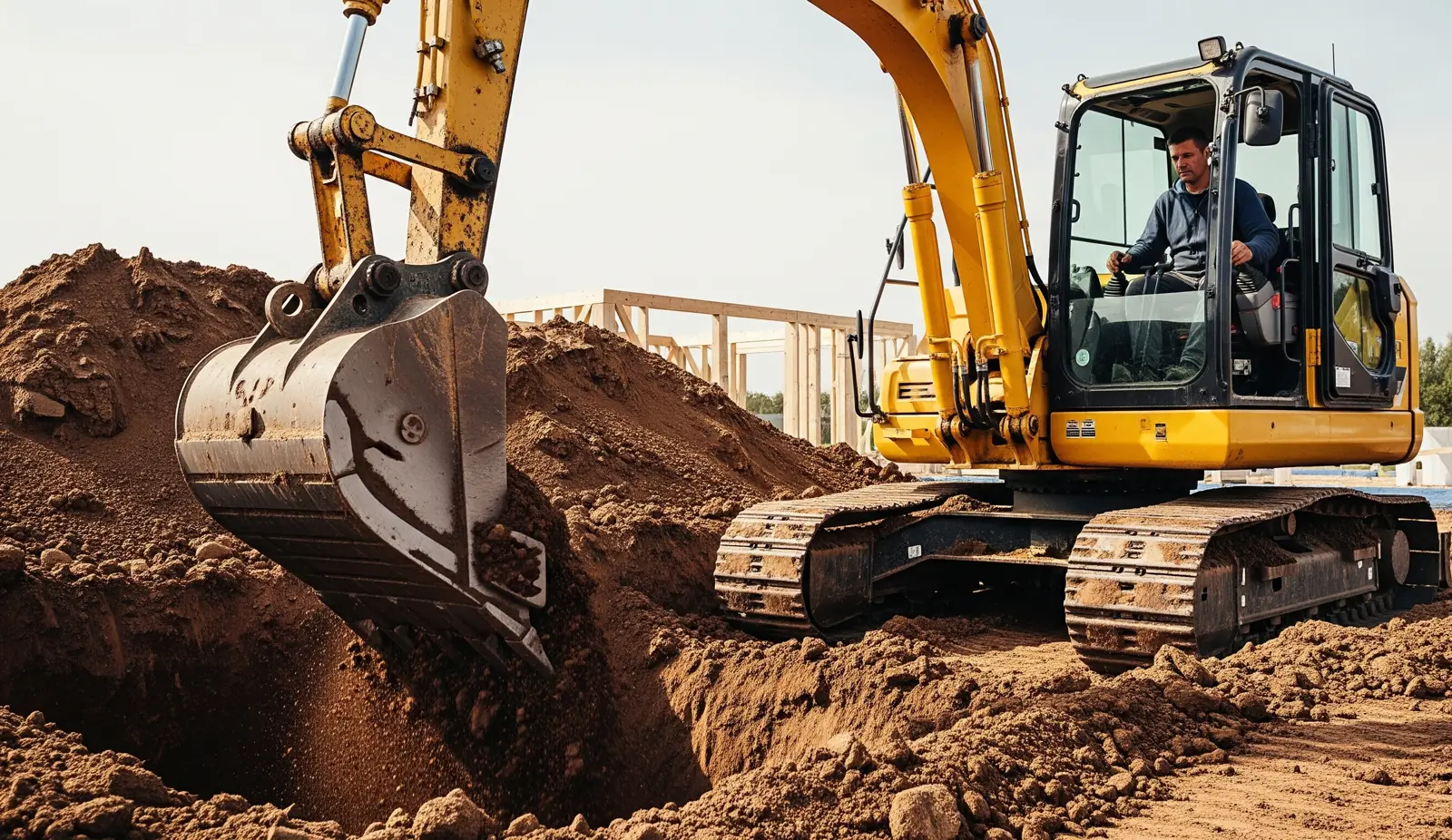
What drives the cost and schedule of site excavation
The ground decides more of the price than the size of the house does. Two lots a mile apart can be completely different jobs. The main factors:
- Rock. In the mountain towns, bedrock can show up a few feet down, and the glacial till above it is packed with stones and boulders. Ledge in the footprint means slow digging, hammering, or a change to the design. See rock and boulder removal.
- Access and slope. A steep wooded lot with a narrow way in takes more machine moves than an open field, and the concrete trucks need a way in too.
- Water. A high water table, or clay that holds water like much of the ground near the Hudson, means pumping and extra stone under the footings.
- Spoil. Every yard that comes out of the hole has to go somewhere. Room to stockpile it on site is far cheaper than trucking it away.
What should you have ready before the excavator shows up?
Have the house or addition staked with a height benchmark set, your building permit in hand if the town requires one, and a clear plan for where the topsoil and spoil piles will go. Point out anything buried that isn't a public utility, like a well line, septic pipe or propane line, and make sure trucks can reach the hole.
Private lines matter because a utility locate only marks the public ones. If you know where your well line or old septic pipes run, tell Justin before the dig. If trees stand in the footprint or the driveway path, the lot needs land clearing first, and stumps have to come out completely, roots and all, anywhere the house or driveway will sit.
Mistakes that cost you later
Most foundation problems start in the hole, long before anyone sees a crack. These are the ones worth avoiding:
- Pouring footings on fill, or on mud that sat under water overnight. It settles, and the cracks show up a year or two later.
- Mixing topsoil into the backfill. Keep it separate and spread it last. Buying it back is expensive.
- Backfilling before the walls are cured and braced. Heavy, wet backfill can push a green wall in.
- Throwing stumps, big boulders or construction debris against the foundation. They rot, settle or point-load the wall.
- Leaving the yard flat or pitched toward the house. Water will find the basement.
Don't pour a slab or patio on fill that hasn't been compacted in lifts, either. When the digging is done, grading and landscape prep sets the final slope, and drainage work handles any water the grading alone can't.
Word around town
From customers who called Justin.
Justin did an outstanding job! He excavated the site for setting (6) - 4' tapered precast piers to support a covered front porch I am building. He was quick to respond… making sure that all the Utilities were marked and the site was safe. He did what he told me he was going to do and did more than what was expected.
Justin's done several jobs for us, each one terrific. He just cleaned out some old foundation walls that had been neglected for 20 years, and did a precision job in less than a day. He's smart and solves problems if they arise. As a plus, he has a sense of humor!
Straight answers
Site Excavation & Prep: common questions
How much does site excavation cost?
It depends mostly on the ground: rock, water, slope, access and where the spoil goes. Justin walks the site for free and gives a straight price once he's seen what he's working with. If rock or water turns up that nobody could have seen, he'll tell you right away before going further.
Do I need a permit to dig a foundation?
The building permit for the house or addition generally covers the foundation work, and most towns want to inspect the footings before concrete goes in. Rules vary from town to town, so check with your local building department before scheduling the dig.
Can you dig a foundation in winter?
Often, yes, as long as the frost isn't too deep and the concrete crew can protect the footings from freezing. Spring thaw is usually the harder time, because the ground turns to mud and some local roads get weight limits.
Do you take small jobs like porch piers and additions?
Yes. Pier holes for a porch or deck, footings for an addition, and garage slabs are all part of the work. Small jobs get the same care on depth and cleanup as a full basement.
Is there a site excavation contractor near me?
If you're within about 45 minutes of Palenville, most likely yes. Justin works across Greene, Ulster and Columbia counties, from Hunter and Windham to Kingston, Hudson and Kinderhook. Call (518) 947-4330 to set up a free site visit.
Often paired with
Related work.
- Clearing
Land Clearing
Brush, stumps and small trees cleared for house sites, driveways and fields.
- Grading
Grading & Landscape Prep
Rough and fine grading, compacted fill and topsoil ready for lawn, patio or beds.
- Rock
Rock & Boulder Removal
Boulders, ledge and stony till dug out, reused on site or hauled away.
No charge to look
Get a free quote.
Tell Justin what you've got going on. He'll call you back, come out and walk it, and give you a straight price.
(518) 947-4330 jmhoeing@yahoo.com- Free estimates on every job
- Licensed & insured
- Underground utilities marked before we dig. Justin handles it.
- Emergency calls answered 24/7