Excavation services
Rock and Boulder Removal in the Catskills & Hudson Valley
Rock and boulder removal is part of almost every dig in the Catskills, where glacial till is packed with stones and bedrock can sit just a few feet down. Justin figures out what you're dealing with, what can come out with the machine, and what's smarter to leave in place or build around.
Why the Ground Here Is So Rocky
Blame the glaciers. When the ice sheets pulled back, they left till behind: a dense mix of clay, sand, gravel and stones of every size, from cobbles to boulders bigger than a pickup. In the mountain towns like Windham and Hunter, that till is often thin over bedrock. Around Woodstock and Saugerties, flat bluestone ledge shows up in layers. Every old stone wall running through the woods is a record of farmers pulling rock out of their fields by hand.
What that means for you: nobody can promise what's down there until digging starts. Justin can read a lot from the surface, from outcrops, from what came out of nearby holes, and from a test hole when the job warrants one. But rock is the biggest unknown in excavation around here, and an honest estimate says how it will be handled if it shows up.
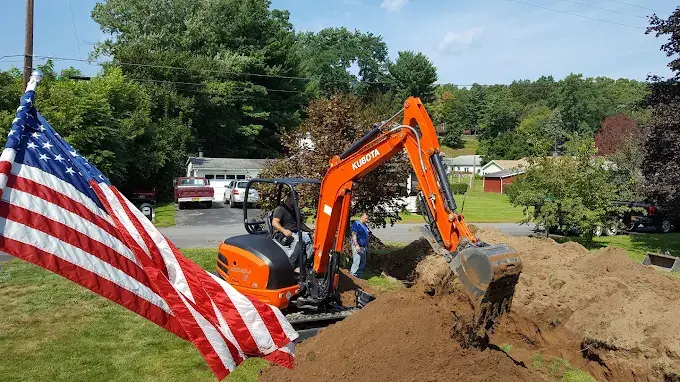
Rock and Boulder Removal: Bucket, Breaker or Build Around
Loose boulders in till are the easy case. The machine digs around them, gets under an edge, and rolls them out. Big ones get set aside, not buried. A boulder left under a slab or footing becomes a hard spot that cracks it when the soil around it settles.
Ledge is different. Fractured or layered rock can often be pried apart along its seams with the bucket teeth. Solid bedrock needs a hydraulic breaker, which is slow, loud work paid for by the hour. Blasting is a separate specialty with its own licensing and permits, and most residential jobs never get near it.
Sometimes the best move is to leave the rock alone. Raise the house a foot, shift the pool, run the trench a different way, or step the footing onto the ledge. Clean, solid bedrock is excellent bearing for a foundation when it's prepared properly. Justin will tell you when changing the plan saves more than fighting the rock, which is often the case with site excavation on steep mountain lots.
How Much Does Rock Add to an Excavation Job?
It depends on the kind of rock and how much of it there is. Scattered boulders in till add some time for digging and handling. Solid ledge that has to be broken can take many times longer than digging the same volume of soil, plus haul-off. That's why a fair estimate spells out how rock is priced, usually by the hour or the load, before work starts.
Haul-off is the other half. Rock is heavy, so a truck hits its weight limit long before it looks full. Every load you can keep on site is money you don't spend on trucking.
Putting the Stone to Work, and What to Avoid
Good stone is worth keeping. Large flat boulders make natural-looking retaining walls and steps. Rounded ones can edge a driveway or anchor a garden bed. Smaller stone can go where drainage matters, like behind a wall. Tell Justin before the job what you'd like kept and where it should go, so it gets set aside instead of loaded on a truck.
A few things to avoid:
- Burying boulders under a lawn, driveway or patio. Frost works them up and the ground settles unevenly around them.
- Backfilling foundation walls with rocky spoil. Stones against a wall can damage it and the waterproofing.
- Pulling big rocks out of a slope without a plan. Some of them are what's holding the bank.
- Assuming a yard full of surface stones means ledge. Often it's just till, and it digs fine.
Word around town
From customers who called Justin.
Justin has done several jobs for us always professional and courteous even when we change things in the middle of the project! Job sites are clean, neat and work is amazing. Highly recommend his work.
Straight answers
Rock & Boulder Removal: common questions
Can you remove one big boulder from my yard?
Yes. A partly buried boulder is usually bigger underground than it looks on top, so the hole it leaves needs filling and compacting. Justin can haul it away or set it somewhere useful on your property.
Is blasting ever needed for residential rock removal?
Rarely. Most rock can be dug, pried apart or broken mechanically, or designed around. Blasting is a specialty with its own licensing and permits, and Justin will tell you honestly if a job ever gets to that point.
Why can't you tell me exactly how much rock is under my site?
Because till and ledge change over just a few feet, and nobody can see through dirt. Test holes help, and so does knowing the ground in your area. A good estimate explains how rock will be handled and priced if it turns up.
Do you do rock removal near me in the Hudson Valley?
Yes. Justin pulls rock in ten towns around Palenville, from Hunter and Woodstock to Hudson and Kinderhook. The mountain towns see the most ledge, while the river towns lean toward clay with scattered stones. Call (518) 947-4330 for a free site walk.
Often paired with
Related work.
- Site Prep
Site Excavation & Prep
Foundation digs, footings, pier holes and backfill for homes and additions.
- Clearing
Land Clearing
Brush, stumps and small trees cleared for house sites, driveways and fields.
- Walls
Retaining Walls
Block, stone and boulder walls built on a real base with drainage behind them.
No charge to look
Get a free quote.
Tell Justin what you've got going on. He'll call you back, come out and walk it, and give you a straight price.
(518) 947-4330 jmhoeing@yahoo.com- Free estimates on every job
- Licensed & insured
- Underground utilities marked before we dig. Justin handles it.
- Emergency calls answered 24/7